REVIEW · WORKSHOPS
Woolf & Dickens: London Literary Tour & Writing Workshop
Book on GetYourGuide →Bookable on GetYourGuide
Good writing starts with looking closely.
This small-group tour turns famous London scenes into short, guided writing exercises, with literary prompts built around Virginia Woolf, T.S. Eliot, Dickens, and Samuel Johnson. I love how the activities stay grounded in real places, starting with the view from Waterloo Bridge, then moving into spaces where you can feel time, language, and power in the walls around you.
The second thing I really like is the way the session is run: the guide Joseph keeps things welcoming, safe, and focused on your effort, not your skill level. You get brief readings, then you create your own response, whether you’re brand new to writing or you already have pages in progress.
One possible drawback: you have to be willing to write. If you want a purely sit-and-listen sightseeing tour, the workshop part will feel like work, not just entertainment.
In This Review
- Key points at a glance
- From Waterloo Bridge to words on the page
- Meeting point behind Somerset House: getting oriented fast
- Waterloo Bridge and Woolf: writing with a moving view
- Somerset House mindful writing: slow attention in a busy city
- St Mary Le Strand and Eliot’s time: ekphrasis inside a church
- Aldwych timeline prompts: history as a sequence, not a slogan
- Gladstone statue and the politics of truth
- Dickens and Samuel Johnson: truth, language, and power
- Doctor Johnson’s house and the dictionary reading
- Who this tour is for (and who should skip it)
- Price and value: is $101 worth 1.5 hours?
- Should you book Woolf & Dickens?
- FAQ
- How long is the Woolf & Dickens London Literary Tour & Writing Workshop?
- What is the price per person?
- Do I need entry tickets for the stops?
- Where is the meeting point?
- What should I bring?
- What will we do during the tour?
- What is the tour language?
- Is the tour wheelchair accessible?
- What is the cancellation policy?
- Is there a reserve now & pay later option?
Key points at a glance
- Waterloo Bridge as your opening prompt, tuned to Woolf’s way of blending past and present
- Somerset House mindful writing, using your senses instead of trying to force a perfect sentence
- St Mary Le Strand + ekphrasis, where you translate what you see into words
- Time and timelines at Aldwych, echoing Eliot’s fascination with history and sequencing
- Gladstone, politics, and truth through perspective, followed by a facts-and-memory exercise
- Doctor Johnson’s dictionary reading, then a practical look at how language shapes identity
From Waterloo Bridge to words on the page
This tour is built for people who like cities, books, and the small discipline of putting thoughts into sentences. It’s not just literature talk. You’ll use London as your prompt, then produce a piece of writing you can take home, or at least keep as a reference for future drafts.
For the price, you’re paying for coaching plus movement plus literary close-reading in a tight 90-minute window. That matters in London, where “value” often evaporates when tours turn into long walks with minimal interaction. Here, the interaction stays constant: you look, you respond, you write, you adjust, you share if you want.
Meeting point behind Somerset House: getting oriented fast
You’ll start at the north end of Waterloo Bridge. Look for the slope on the right that goes behind Somerset House, and meet there.
This is a smart start. You’re positioned where you can immediately connect view and text, because Woolf’s prompt is tied to what you can see across the Thames. It also helps you get your bearings quickly, so you’re not spending the first 20 minutes asking where to stand.
Bring what the tour requests: a pen, water, and a notebook. You’ll also want internet access, since the session’s format can involve checking or using something on your phone or device during the writing activities. And yes, London weather can be rude, so an umbrella is a good idea.
Waterloo Bridge and Woolf: writing with a moving view
The Woolf segment is the tour’s tone-setter. You’ll consider her wistful reflections on the view from Waterloo Bridge, then you’ll write a biographical sketch inspired by what’s in front of you.
Here’s why this works so well for your writing practice. Woolf’s style often plays with time—past feelings braided into present observation. So your task isn’t just to describe the bridge. It’s to connect place to memory, and observation to inner life.
A practical tip: when you start writing, don’t chase elegance. First, write down five concrete details you can see or notice. Then write one sentence about what those details stir up in you. That’s the bridge between “scene” and “biography,” and it keeps the exercise from turning into a blank-page panic.
Somerset House mindful writing: slow attention in a busy city
Next comes Somerset House, where you practice a mindful writing experiment. The goal is not to “perform” mindfulness. It’s to slow your attention enough that your words have something specific to hold onto.
Somerset House gives you a kind of contained atmosphere compared to the open sweep of Waterloo Bridge. That’s useful. Your brain stops bouncing between too many signals, and you can actually catch the small sensory cues that good writing depends on: light, texture, movement, the feel of the space.
Mindful writing sounds soft, but it’s practical. You’ll likely work in short bursts, then refine based on what you notice. If you’re a novice, this structure gives you permission to start small. If you’re experienced, it can still reset your habits by nudging you away from autopilot phrasing.
St Mary Le Strand and Eliot’s time: ekphrasis inside a church
At St Mary Le Strand, the focus turns to T.S. Eliot and his study of time. You’ll respond to his ideas, then practice ekphrasis—writing inspired by the church’s grand interior.
Ekphrasis can sound fancy, but the task is straightforward: translate what you see into language in a way that captures mood, order, and feeling—not just a list of features. In a church setting, that often means thinking about height, light, shadow, the rhythm of arches or columns, and the way sound might behave in the space.
The drawback to keep in mind: you might feel self-conscious if you’re not used to writing in public. That’s where the tour’s tone matters. The guide keeps the environment kind and inclusive, and the prompts are designed to let you make the writing your own.
If you get stuck, write the “present-tense version” first. Instead of trying to sound like Eliot, focus on what the room is doing to you right now: what it emphasizes, what it delays, what it suggests about time moving forward.
Aldwych timeline prompts: history as a sequence, not a slogan
The session also ties Eliot’s reflections to a timeline on the walls at Aldwych. You’ll use that visual cue to think about history as sequence—events stacked, linked, and interpreted through what comes before and after.
This stop is valuable because timelines can do two different things. They can flatten complexity into easy dates, or they can help you notice how meaning changes with order. The exercise pushes you toward the second option: writing that respects the structure of time while still acknowledging how perspective shapes what you “see.”
A helpful approach: choose one point on the timeline and treat it like a character. Ask what it implies, what it hides, and what it causes later. Then write a short response that connects the timeline to your own sense of time—how you remember, what you skip, and what you insist on keeping.
Gladstone statue and the politics of truth
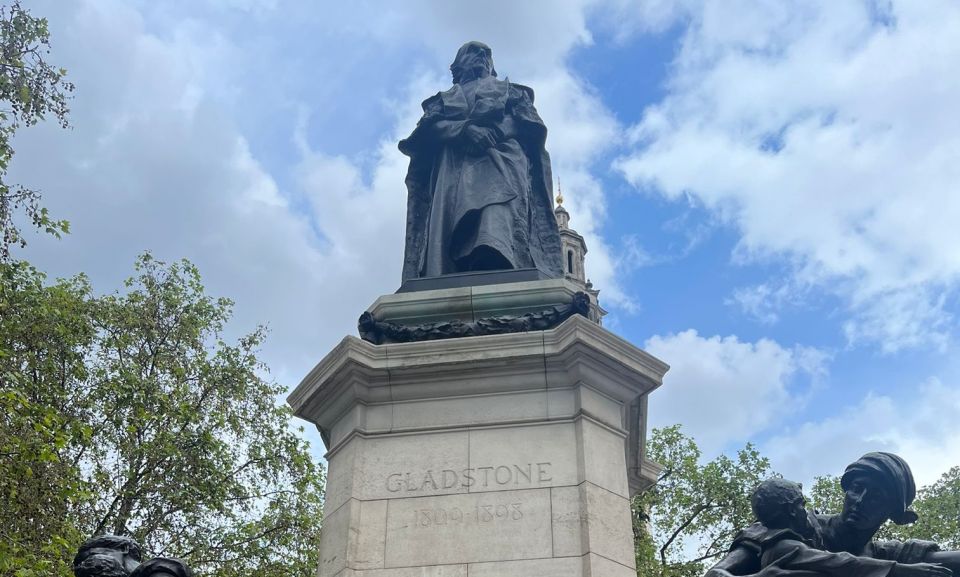
Then you’ll come to a statue of Gladstone, where the prompt shifts toward politics, truth, and history—specifically how they change depending on where you stand.
This is one of the most useful parts of the tour if you like writing that doesn’t pretend to be neutral. The exercise is essentially perspective practice. You’ll be asked to reflect on the way “truth” is shaped by context, and how history can look different once you change the lens.
You’ll write a list of facts, blending personal history with the environment you’re part of. That combo is important. Facts are not just external data; they’re also the ones you carry—what you believe, what you learned, what you were taught to dismiss.
Practical advice for the list exercise: make the first pass only facts you can verify, then make a second pass that labels your interpretation. For example: Fact: I’m standing here. Interpretation: This place makes me think of politics as performance. That separation usually makes your writing clearer and stronger.
Dickens and Samuel Johnson: truth, language, and power
At some point in the flow, the prompts bring in Dickens and Samuel Johnson to help you reflect on truth and politics. You’ll use them as starting points for your own thinking, not as rules you have to follow.
This matters because Dickens and Johnson don’t represent one simple idea of literature. They represent how language can argue, persuade, define morality, and expose hypocrisy. Even when your writing is small, those authors give you permission to treat words as tools, not just decoration.
If you’re unsure how to respond, look for the “question inside the prompt.” With truth and politics, the question is often: who gets to define what counts as true? Then your writing becomes an exploration of that power, using whatever details you can pull from your own day-to-day life.
Doctor Johnson’s house and the dictionary reading
The tour ends in spirit at Doctor Johnson’s house with a reading from his dictionary. From there, you’ll consider how structures—religion, politics, art, language—help shape who we are.
This stop is quietly brilliant for writers because it shifts you from metaphor to mechanics. A dictionary represents categories. Categories represent how a society names the world. Naming shapes thought, and thought shapes behavior.
In practice, the dictionary reading gives you a concrete anchor. You can stop guessing what “writing well” means. You can focus on how words work, how definitions frame emotion, and how your own vocabulary quietly reveals your values.
Who this tour is for (and who should skip it)
You’ll probably love this if you:
- want guided writing prompts tied to real London locations
- enjoy short readings and then hands-on response time
- like atmosphere, but also like doing something with it
- want something that works whether you’re new to writing or already experienced
You should probably skip it if you:
- want a passive tour with no writing requirements
- hate being asked to participate in short exercises in a group setting
- prefer long museum-style explanations over quick creative tasks
The best part is the balance. You get literary ideas without turning it into a lecture. You get writing without turning it into a therapy session. And you get to walk through places that feel like they’re still thinking.
Price and value: is $101 worth 1.5 hours?
At $101 per person for 1.5 hours, the value depends on your motivation. If you’re looking for a standard sightseeing run, it’s pricier than you might expect. If you’re looking for writing coaching in motion, it’s much easier to justify.
Here’s what you’re getting for your money:
- a guided tour that includes writing workshop time
- no entry tickets needed
- short readings and prompts built for different levels
- a private group setup (so the experience can stay more personal)
Even if you only produce a page or two, the workshop format can pay off if you leave with sharper observation habits. In other words, the real “souvenir” is often the way you learned to turn a street view into sentences you can reuse later.
Should you book Woolf & Dickens?
I’d book it if you’re the kind of person who likes to travel with a pencil. This tour gives you structure, literary inspiration, and a kind learning space run by Joseph—plus enough variety across Woolf, Eliot, Dickens, and Johnson to keep the writing tasks from feeling repetitive.
I’d pass if you want only classic landmarks and quiet commentary. This is a workshop. The trade-off is that you’ll spend some of the 90 minutes making words, not only looking.
If you can meet the tour halfway with a pen, curiosity, and willingness to try a few short experiments, you’re likely to come away feeling both entertained and more awake as a writer.
FAQ
How long is the Woolf & Dickens London Literary Tour & Writing Workshop?
The workshop lasts 1.5 hours.
What is the price per person?
The price is $101 per person.
Do I need entry tickets for the stops?
No entry tickets are needed.
Where is the meeting point?
Meet at the north end of Waterloo Bridge, at the slope on the right that goes behind Somerset House.
What should I bring?
Bring a pen, water, and a notebook. An umbrella is recommended just in case, and internet access is also requested.
What will we do during the tour?
You’ll do a guided tour combined with writing exercises prompted by readings from major English writers and by what you see at each location.
What is the tour language?
The tour is in English.
Is the tour wheelchair accessible?
Yes, the tour is wheelchair accessible.
What is the cancellation policy?
You can cancel up to 24 hours in advance for a full refund.
Is there a reserve now & pay later option?
Yes. You can reserve your spot and pay nothing today.